5 easy changes that will actually improve your life
In a world where everything seems to promise some form of 'optimisation', our experts suggest small, simple changes that will genuinely make things a bit better.
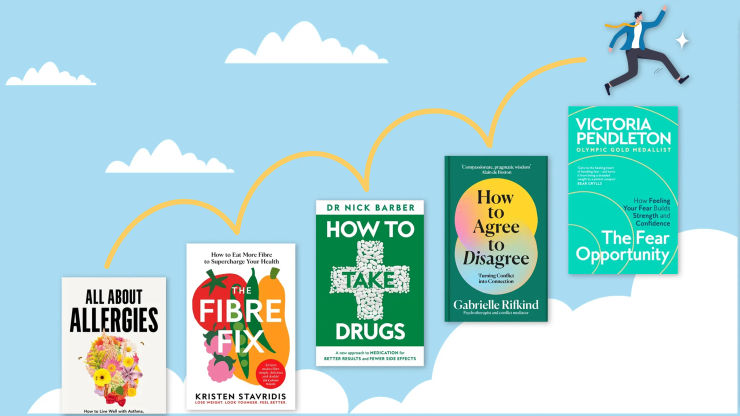
From changing how you prep your veg to using a simple three-letter word a bit more often, we've gathered together advice from some of our brilliant authors – including an award-winning pharmacologist and a former Olympic champion – that actually works.
1. Take a notebook to your GP appointment
Dr Nick Barber, Emeritus Professor of Pharmacy at UCL, wants to help you improve your relationship with the medicines you take. His book, How to Take Drugs, aims to arm you with the tools you need to be clear about what you want from your medicines, and know how, as much as possible, to make them deliver. An important part of this is getting the most from your appointments with clinicians, and a good way to do that is to come prepared. Here are four pieces of advice to keep in mind for your next appointment.
- Take someone with you. 'A consultation with a doctor can feel overwhelming, so it may be helpful to take your partner or a friend who can also listen and ask for clarification,' says Dr Barber.
- If you are offered a diagnosis, ask the doctor to repeat it and write it down for you. 'Everybody’s
brain turns to mush when they’re in a consultation and very little of what is said to them is remembered afterwards,' Dr Barber explains. 'By getting the diagnosis written down, you have a reference point for later, and gain a few seconds’ pause to gather your thoughts.' - Ask to explore the options, using the acronym NARB as a question prompt: What would happen if you did nothing? What are the alternatives to drug treatment? What are the risks and benefits of these alternatives, and any suggested drug treatment?
- Remember that you are allowed to think about it. 'It is not only acceptable, but often sensible to also ask for time to consider and send back a decision. You could say, ‘I’d like to find out a bit more about that before making a decision. Can I book another appointment in a couple of weeks, or text you with my decision?’
Further reading: How to Take Drugs by Dr Nick Barber
2. Prone to arguments? Make judicious use of your drafts folder
When we're hurt, our immediate instinct is often to retaliate. 'We want to hit back so that they experience at least the same degree of pain,' explains Gabrielle Rifkind, who has worked as a probation officer, psychotherapist and international conflict mediator. 'We see this behaviour in war. . . Acting on this impulse temporarily restores dignity so [the wounded] no longer feel like the weaker party, but it also creates cycles of violence. When retribution is the default position, endless suffering results.'
This is also the case, albeit on a less dramatic scale, in our daily lives. 'There have been countless times when an incoming email has made my blood boil and I’ve wanted to hit back with a note of irritation and sarcasm,' Rifkind admits. If you can't help but hammer out an immediate response – whether via email, or text message – do so, but don't send it. 'You need to find your pause button and, before responding further, allow your emotions to settle,' Rifkind advises. Save something to drafts, go for a walk, sleep on it. Whatever calms you down. 'What matters is shifting from a hot, reactive state to a cooler, more reflective one.' You can then redraft a more measured response, and prevent a spiral (and future regret).
Further reading: How to Agree to Disagree by Gabrielle Rifkind
3. Stop peeling your fruit and veg
'Most of us peel fruit or vegetables simply out of habit, but this peel holds valuable fibre and nutrients that support your health,' says Kristen Stavridis, author of The Fibre Fix. 'Peeling a large apple, for example, can reduce its fibre content by up to 1.5g, while removing the skin from a medium potato can reduce its fibre content by half.' This also applies to nuts – the papery brown layer around Brazils and hazelnuts is a great source of fibre and antioxidants. When it comes to your greens, you just need to make sure you wash the skin thoroughly. If you're worried about pesticides, you can soak fruit and vegetables in a bicarbonate of soda solution: 'Put 1.5 teaspoons in a big clean sink full of clean water, add your fruit and veg and allow to soak for about 12 minutes, then rinse everything well with clean water and pop back in the fridge.'
Further reading: The Fibre Fix by Kristen Stavridis
4. Don't make your bed straight away in the morning
If you have a dust mite allergy, efficiently making your bed as soon as you get up could actually be making it worse. According to allergist and immunologist Dr Zachary Rubin, it can trap moisture in the bedding and increase dust mite allergens. It's better to wait a few hours before making your bed so any moisture dries out more effectively. 'The bedroom is one of the most important places in the home for reducing allergen exposure because that is where most people spend most of their time in their homes,' he adds. 'Your immune system has a circadian rhythm and operates differently at night while you sleep, so you may be more susceptible to allergens during this important resting period.'
Further reading: All About Allergies by Dr Zachary Rubin
5. Want to give up giving up? To change your mindset, just add 'yet'
In her new book, The Fear Opportunity, one of Britain’s most successful Olympians, Victoria Pendleton, highlights research done in the 1990s by Dr Carol Dweck at Stanford on motivation and personality, comparing 'fixed' and 'growth' mindsets. 'In a fixed mindset, we believe our abilities are static; they are connected to our intelligence or innate physical traits. But with a growth mindset, we see ability as something that grows with effort.' Those with a fixed mindset are much more likely to give up when facing something difficult, whereas those with a growth mindset are more likely to carry on and improve. 'A growth mindset is an incredibly powerful thing, and it is also, wonderfully, something that we can learn,' says Pendleton, who goes on to explain how, in Dr Dweck’s research, a change in mindset could be attained by adding the word 'yet' to any statement about what we can do.
'I cannot code' becomes' I cannot code yet'. 'I can't run a 5k' becomes 'I can't run a 5k yet'. If you reframe not being able to do something as a starting line, rather than a permanent failure, you open yourself up to achieving it in the future.
Thrill-seeker Pendleton applies this to freediving: 'A fair assessment of my current ability would be: I cannot freedive. An even fairer, equally honest but altogether more empowering one would be: I cannot freedive yet,' she says. 'I am hard-pressed to think of two statements that are so similar in their contents but so different in their outcome,' she continues. 'The word ‘yet’ is a transformer, loaded with possibility and imbued with the sense of a growth mindset that could be applied to all manner of new challenges in our ever-changing lives.'
Further reading: The Fear Opportunity by Victoria Pendleton