Authors' Notes: Patrick Radden Keefe on London Falling, true crime and tragedy
As the award-winning investigative reporter and author turns his attentions to London, we ask him about his new book, how he gets people to open up, and balancing empathy with the draw of a great mystery.
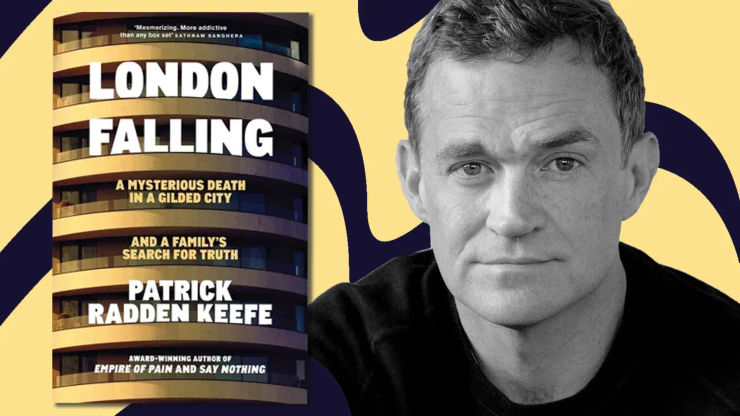
Patrick Radden Keefe is one of those rare things: a writer of non-fiction whose books genuinely have the pace and feel of a great novel. His exposé of the Sackler family, Empire of Pain, is widely regarded as one of the best non-fiction books of all time, and his new book, London Falling, is set to be one of the biggest and best non-fiction books of 2026. It tells the true story of a teenage boy, whose mysterious death on the bank of the Thames leads to his parents' discovery of a secret double life. In this edited extract from our interview with him, the author explains how and why he came to tell the story of Zac Brettler.
I had written an essay for the New Yorker shortly after the invasion of Ukraine by Russia about the way in which the Russian oligarchs in London had kind of put Britain in an awkward situation vis-a-vis the Ukraine war. And that was an issue I'd been thinking about. I happened to be living in London over the summer of 2023, and was working on a television series based on my book Say Nothing. I was on set one day and I bumped into a guy who was a guest of the director and we started talking and he said 'I might have a story for you. I know this family here in London, who are dear friends of mine, who lost their nineteen-year-old son recently. He died under mysterious circumstances and after his death they learned that he had a secret life, a double life that they hadn't known about.'
The son had been moving around London as a teenager pretending that he was the son of a Russian oligarch. And that was pretty much all he had to say to me before I knew that this would be the next thing I worked on, the next story I would try and tell. I needed to figure out if the family would be willing to open up to me and tell their story. But it felt like an opportunity to take the kind of broad set of issues that I was interested in about London and how it had changed, and foreign money and the kind of post-Soviet oligarch presence in the city, and examine it through the lens of a very intimate story about one family and a boy who became kind of caught up in that side of the city.
London Falling seems to inhabit a unique space between a heartbreaking family tragedy told with empathy, and an addictive true crime exposé. As a writer, how do you balance what could be quite disparate tones and pace, to create a book which is both compassionate and propulsive?
One of my dearest friends in the world, who's one of my first readers, he read the book and he said it's so interesting because the first half of the book you think it's a mystery and then in a kind of strange way it turns out it's actually a book about grief and about parental love.
And that was kind of my experience too. What what drew me to the story on the front end was the intrigue: it's just such a wild story of this young fabulist in London pretending he's the son of a Russian oligarch and, you know, as a teenager going out and kind of mixing it up with these quite unsavory figures in London [. . .] But then there was this sort of interesting turn for me as I got to know Matthew and Rachelle [Zac's parents] and Zac's brother Joe better, where I realized that it's a story about parenthood and about loss.
When you were writing London Falling, to you, did the book feel more like a true crime exposé or a tragedy? Were you driven more by piecing together the underworld's mechanics and corruption, or by the emotional weight of documenting Zac’s personal undoing?
Part of what drew me to this story as a story is that it's a mystery. This young boy dies, how did he die? Was he murdered? Was it suicide? Was it something more exotic? And how had he kind of created this double life, this secret life? How had he gotten away with that? Who was he pretending to be? What were the origins of that?
In the beginning, you think that the people who are going to be solving the mystery are the authorities. It's Scotland Yard, they come in. It's the Metropolitan Police. I grew up reading Sherlock Holmes, right? There's a kind of tradition of the story in which the investigators come in and help the civilians with whatever the bedeviling trouble is that they're reckoning with. In this case what happened was the authorities came in and said, 'Oh of course we'll we'll throw the full weight of the Metropolitan Police behind solving this case.' There's actually a line where they said, 'In the end there will be no questions that haven't been answered,' which they told the family. And then proceeded to not really investigate. Not in any thorough way.
‘It's a story about this couple, Matthew and Rachelle, whose son Zac dies and they then have to essentially become investigators themselves. In the vacuum in which the authorities don't come and help, they have no choice but to become the detectives. And in so doing, they enter into this side of their own city, this underworld, that they'd never really been fully aware of.’
And so it's actually a story about this couple, Matthew and Rachelle, whose son Zac dies and they then have to essentially become investigators themselves. In the vacuum in which the authorities don't come and help you, they have no choice but to become the detectives. And in so doing, they enter into this side of their own city, this underworld, that they'd never really been fully aware of.
Because Zac was mixing it up with gangsters and dodgy businessmen and there's a whole kind of subculture in London beneath the gleaming surfaces, in which there's a lot of kind of transactional hustle, a lot of slightly shady things going on. And Matthew and Rachelle have to plunge into that netherworld in order to figure out what happened to their son. So, to me, that's a story both about their tenacity as grieving parents in getting some answers that weren't afforded to them, and about the way in which the systems and structures that should be here to look out for civilians in a big city like London have failed them.
You've spoken previously about the power of the 'write around' – writing about powerful people who refuse to talk to you. In the case of Zac’s story, how did you navigate the lack of cooperation from some of those involved?
I think one of the things that I love most about the work that I do as a journalist and an author is that I am constantly having to kind of go outside my own comfort zone and my own circle and my own life and meet all kinds of different people. And I sort of meet them where they are. So it could be undocumented immigrants from China, it could be very senior government officials, it could be professors at universities with PhDs, it could be gangsters, murderers, people who've kind of lived their lives in the underworld.
And so you have all these different types of people and I have to find them and find a way to forge a relationship, sort of find some conversational wavelength where we can see each other and communicate, ideally in a way that feels pretty forthright and candid. And what that means for me is I have to keep myself very open and often listen without judgment.
‘If I come and meet you, no matter who you are, no matter what you've done, my first objective is to make myself open to hear your story in your words and try and understand the world as you see it, even if I don't see it that way – maybe especially if I don't see it that way.’
And it doesn't mean that I'm not going to pass judgment, because if you read my work, it's there. I'm certainly not trying to whitewash anything that anybody does when I sit down to write. But if I come and meet you, no matter who you are, no matter what you've done, my first objective is to make myself open to hear your story in your words and try and understand the world as you see it, even if I don't see it that way – maybe especially if I don't see it that way.
So that's what I'm always trying to do. And it doesn't always work. Sometimes people refuse to talk to me, sometimes they start talking to me and then they change their minds and they go dark on me. When it works, it's really extraordinary and it feels on the one hand like the most natural thing in the world, in the sense that I think that all of us have a story to tell, all of us really in the end want to be understood. And, on the other hand, like a real privilege for me to be somebody who hears people's stories, and ideally hears stories that haven't been told before.
Watch the full interview here
London Falling
by Patrick Radden Keefe

Why read this: A gripping true story that exposes the hidden forces shaping modern London, this is the latest compelling read from the bestselling author of Empire of Pain and Say Nothing. When teenager Zac Brettler falls to his death from a luxury riverside apartment, his parents uncover a secret double life and are drawn into a world of extreme wealth, deception and danger. Patrick Radden Keefe blends forensic reporting with emotional depth, revealing how a global city’s glittering surface can conceal darker truths about power, identity and inequality. It’s both a heartbreaking family story and a sharp portrait of a city in flux.
If you’re looking for: Investigative journalism, true crime, modern London, extreme wealth, narrative non-fiction.
Great for fans of: Empire of Pain by Patrick Radden Keefe, Butler to the World by Oliver Bullough, A Thread of Violence by Mark O'Connell, Putin's People by Catherine Belton.
What the experts say: ‘Gripping, rigorous and smart . . . breathtaking’ – Jon Ronson, author of The Men Who Stare At Goats and The Psychopath Test. 'More addictive than any box set, London Falling will break your heart, instil you with cold rage, and make you see London in a completely new light' – Sathnam Sanghera, author of Empireland.