Everything that's happened in the Children of Time series so far
Want a quick recap before you start Children of Strife? Here's what you need to know, from author Adrian Tchaikovsky himself.

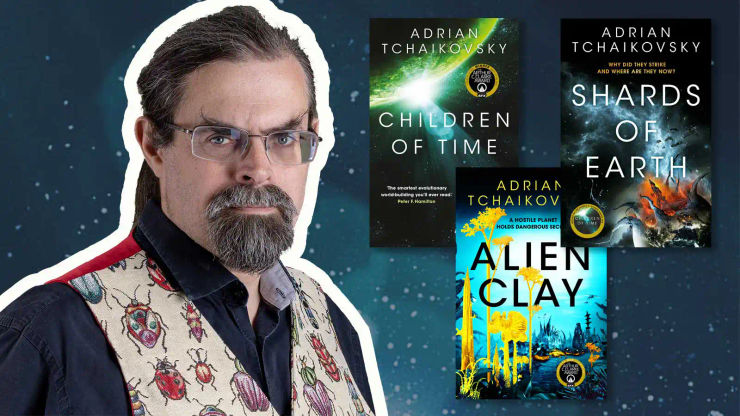
Adrian Tchaikovsky’s critically acclaimed Children of Time is the epic story of a battle for survival on a terraformed planet. The winner of the 2016 Arthur C. Clarke Award for Best Novel, it was followed by two further books, Children of Ruin and Children of Memory, and now a fourth, Children of Strife. If you're about to get started on the latest in the series and need a quick reminder of what's happened to humanity before digging in, you're in the right place. Here, author Adrian Tchaikovsky reviews everything's that happened so far, and the details you need to remember for the next book.
WARNING: this article contains spoilers for books one – three. If you're new to the series, take a look at our guide to Adrian Tchaikovsky's books in order to find out where to start.
The universe of the Children of Time series
Humanity has gone to the stars, visited exoplanets and chosen some to terraform into new Earths, under the oversight of maverick misanthrope Avrana Kern. War and societal collapse bring an end to Kern’s civilization before she can finalise her plans, though, and the final act back home is to send out a shutdown virus that disables all technology. The signal spreads out into the universe and all the lights of human presence go dark.
The war plunges Earth into an ice age, but human society slowly claws itself back over long ages, inheriting a poisoned and dying world. At the last, the final generations construct ark ships and set out, using ancient maps to try to find the terraformed worlds they believe will be a new paradise. Some of those worlds are lifeless rocks, others unfinished and uninhabitable. A few have fulfilled their potential, but on some new life has evolved, accelerated by Kern’s uplift virus. Humanity is heading for a clash of cultures and species.
The story so far
Children of Time
by Adrian Tchaikovsky

Avrana Kern survived the destruction of her terraforming station by putting herself into suspension, merging her mind with an artificial intelligence. She expects to wake to a world of sapient, civilized monkeys, but while the uplift virus was delivered, the monkeys were not. Instead, what evolves on her world is a species of jumping spider, the Portiids. Over long ages they crawl from the stone age to the space age, initially seeing her orbiting satellite as their god, later making contact and incorporating her into their ant-based technology. At the same time, an ark-ship from Earth, the Gilgamesh, is bringing a human population to take up residence on Kern’s world.
On board, Classicist Holsten Mason and Engineer Isa Lain wake repeatedly from cold sleep to watch the ship and the humans aboard it degenerate to infighting, cults and xenophobia. When they reach the world to find it infested with spiders, they react with violence, but the Portiids turn the human-made uplift virus on them, creating a bridge of empathy between the two species to allow for communication and cooperation. The humans are given space for a new home on the world, but more than that, the two species are able to unite with the dream of exploring further worlds and seeking the rest of the terraforming project to see what else survives.
Children of Ruin
by Adrian Tchaikovsky
Back in the age of the terraformers, one of Kern’s teams discovered a system with two habitable worlds. The ocean world of Damascus and the world of Nod, which already had a complex alien biosphere. Yusuf Baltiel, the expedition leader, decided to explore Nod, and left his subordinate Senkovi to work on the terraforming, which Senkovi took as an excuse to uplift his beloved octopuses to sapience to help with the work. When the shutdown virus struck, Senkovi’s octopuses prove the fluke that preserves at least some of the team, but they are left with no functioning project and no home to return to.
On Nod, Baltiel’s team encounter – are infected by – a sapient slime-mould like colony that sets about joyously exploring the human body, eager for new experiences in a way that is catastrophic for the people involved. The Nodan organism has a vast ability to store information within its individual cells, and ‘learns’ the personalities of its former hosts by encysting itself in their brains. Senkovi cuts off all contact with Nod and lives out his life with his octopuses in orbit over Damascus. However, the Nodan life reaches their world long after he dies, with disastrous consequences, leaving the octopuses living in orbit.
Far later, a ship of humans and Portiids arrives, following a trail of radio signals. They encounter both the Nodan organism and the octopus civilization, clash with both but are at last able to initiate communication with the latter. An instance of Avrana Kern – now existing as the chief artificial intelligence within most of the Portiid ships – is able to reach the Nodan lifeform and make it see that if it devours and incorporates all life outside itself – which it is capable of doing – it will be left without stimulation and the 'adventure' it seeks, which realisation allows it to enter into more negotiated and consensual interactions with other species and individuals. Humans, Portiids, octopuses and the Nodan life are now a loose coalition, ready to exploit octopus technology that is just developing a method of faster-than-light travel.
Children of Memory
by Adrian Tchaikovsky
The ark ship Enkidu suffers serious damage arriving at its destination world, that they name Imir. They decamp to the planet’s surface and set up a colony under Captain Heorest Holt, doing the best they can with limited resources. Children are born, the first of whom is a girl, Liff. Over the generations the colony begins to fail, small miscalculations becoming greater and greater problems until they face extinction.
However, something strange is afoot. There are talking animals, a witch in the woods, rumours of others where no others can be, a communal guilt. At the same time the colony is being visited and studied by a panspecific team of Portiids, an octopus and Miranda, a human-seeming host for the Nodan virus. They live amongst the locals, pretending to belong, but Miranda becomes more and more confused as to just what is going on. She relives incidents, exists at different time periods in the colony’s history, and always there is the girl Liff. Plus the witch seems to be Avrana Kern, who is furious with Miranda for some reason. . .
What Miranda discovers – with the aid of the possibly-sapient corvids Gothi and Gethli – is that the colony on Imir died long ago, but discovered the presence of a vast alien machine that has been running a simulation of the colony’s history over and over, in repeated permutations. Her presence – especially the vast consignment of information and personalities that the Nodan lifeform represents – has thrown this exercise out of balance, and Kern is trying to extricate her from it.
After she is freed, she learns that not only is the Imir colony dead, it was never founded. The initial shuttles crashed, and the alien machine constructed a hypothetical colony history from the minds of those aboard. Liff, who had become quite dear to Miranda, and helped free her, never even existed outside the dream of the machine.
Coming next: Children of Strife
Children of Strife
by Adrian Tchaikovsky

There were other, worse terraformers than Avrana Kern. There were more desperate ventures from dying Earth than the Gilgamesh. There is another species that evolved on Kern’s World, and wishes to see the stars. Join Cato the mantis shrimp war hero, traumatised survivor of the god-machine Alis and their crew as they following the trail of human exploration to the world of Marduk, terraformed in the image of a god very different to Kern. A world of impossible orbital jungles, jealous monsters and secrets.